
Shoppers want to know where their coffee was grown and whether their medicine is genuine. Regulators demand proof, counterfeiters keep getting smarter, and one contaminated batch can trigger a multimillion-dollar recall. Yet most supply chains run on scattered spreadsheets that partners can’t easily verify.
Blockchain gives every participant the same shared, tamper-resistant record to work from. What follows covers why transparency breaks down, how blockchain traceability works, where it matters most and what to weigh before adoption.
Why Traditional Supply Chains Struggle With Transparency
A single jar of coffee can pass through a grower, a cooperative, an exporter, a roaster, two logistics firms and a retail chain before anyone buys it. Each party keeps its own records, in its own format, on its own schedule. Visibility breaks down in the gaps between them.
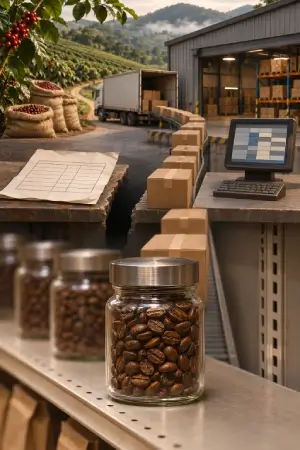
Operational Gaps Between Disconnected Systems
Most supply chains still run on a patchwork of spreadsheets, ERP platforms, emailed PDFs and paper bills of lading. A grower in Guatemala might log harvest dates by hand, while a distributor in Rotterdam uses a warehouse system that cannot read that data at all. Because data standards differ, one shipment can carry three different product codes by the time it reaches a store.
Delays make things worse. Records are often updated days after goods move, and subcontracted carriers or packers may never share their data. Inventory figures drift, and once goods change hands, accountability tends to leave with them.
Regulatory Pressure and Slow Recalls
Regulators now expect traceability records within hours. The FDA’s Food Traceability Rule, with compliance pushed to July 2028, requires firms to produce records within 24 hours of a request. That’s a tall order when tracing contaminated produce means phoning suppliers and digging through archived invoices. In 2018, Walmart found that tracing a package of sliced mangoes back to its farm took nearly seven days using conventional methods.
Slow tracing forces broad recalls. Retailers pull entire product lines because they cannot isolate the affected batch, and the cost lands on everyone in the chain.
Counterfeits, Disputes and Fading Consumer Trust
Opaque handoffs leave room for fraud. Counterfeit medicines, mislabeled seafood and diluted olive oil slip in wherever nobody can verify what happened at the previous step. When provenance is unclear, disputes between suppliers over who handled a damaged or tampered shipment can drag on for months.
Shoppers notice. It’s easy to see why a “sustainably sourced” label carries little weight when the brand behind it cannot show where the product actually came from.
How Blockchain Creates a Shared Record of Product Movement
Every product crossing a supply chain leaves a trail of paperwork, scans and emails scattered across dozens of systems. A blockchain gathers that trail into one decentralized ledger. This is a shared database where each transaction is time-stamped, copied across participants and extremely difficult to alter after the fact.
Product Identification at Source
Tracking begins when a producer assigns the item a unique digital identity, usually through a QR code, RFID tag or batch number. A coffee cooperative in Huila, Colombia, might register a 60-kilogram sack with its farm, harvest date and lot weight. That entry becomes the product’s digital twin, a record that travels alongside the physical goods without ever being the goods themselves.
Data Capture at Each Handoff
From there, every change of custody adds a new entry. Exporters, shippers, roasters and distributors scan the identifier and log details such as location, temperature or inspection results. IoT sensors can feed some of this in automatically, which cuts down on the typos that creep into manual logs.
Validation Across Participants
Before an entry is accepted, the network checks it against agreed rules. Participating nodes confirm that the transaction is properly signed and consistent with earlier records. Smart contracts handle much of this work. These self-executing programs can release payment when a shipment arrives or flag a container of vaccines that spent 40 minutes above 8°C.
Immutable Record Creation
Validated entries are grouped into blocks and linked cryptographically to the ones before them. Changing a past record would mean rewriting every later block on most copies of the ledger, which is why the history is considered immutable. It’s easy to see why auditors like that.
Retailer or Consumer Verification
At the shelf, a grocer or shopper scans the code and sees the product’s full journey. Walmart famously cut the time needed to trace a package of sliced mangoes from nearly seven days to 2.2 seconds this way.
Still, a ledger only records what people tell it. If a supplier mislabels a pallet or skips a scan, blockchain will preserve that mistake faithfully. Reliable, consistent data entry remains the foundation of any traceability program.
Where Traceability Delivers the Most Value
Some products carry far more risk than others when their history is unclear. A mislabelled lettuce shipment, a fake vial of insulin or an undeclared chemical drum can cause real harm, invite regulatory penalties and erode consumer trust overnight. Blockchain tends to justify its cost fastest in sectors where safety, authenticity and compliance leave little room for error.

Food Safety and Faster Recalls
Fresh produce passes through growers, packers, distributors and retailers, and each one keeps separate records. When an E. coli outbreak hits, investigators can spend days reconstructing that path, so retailers often pull entire product categories just to be safe. A shared ledger records each handoff as it happens, which means the affected farm and lot can be isolated quickly.
Walmart tested this with IBM Food Trust and cut the time needed to trace a package of sliced mangoes from nearly seven days to 2.2 seconds. Temperature sensors can also write readings directly to the ledger, giving buyers proof that seafood or dairy stayed within cold-chain limits from dock to shelf.
Pharmaceuticals and Counterfeit Prevention
Fake medicines remain a stubborn public health problem. The World Health Organization estimates that roughly one in ten medical products in developing markets is substandard or falsified. Regulators have responded with strict serialization rules, including the US Drug Supply Chain Security Act and the EU Falsified Medicines Directive, which require unique identifiers on individual packs.
Manufacturers, wholesalers and pharmacies can meet those rules by logging every transfer of a serialized pack on an immutable record. If a batch is recalled, or a returned product resurfaces with a suspicious code, the chain of custody is already documented. Auditors get a verifiable history instead of spreadsheets from five different companies.
Regulated Goods and Proof of Authenticity
Alcohol, luxury items, electronic components and industrial chemicals all face import controls, certification checks and duty obligations. Customs officers want to know where a product was made, whether its certificates are valid and whether the correct tax was paid. So why rely on paper documents that are easy to forge?
A Scotch whisky exporter can attach production records, excise payments and bottling dates to each case, letting distributors in Singapore confirm authenticity before release. The Aura Blockchain Consortium, backed by LVMH, Prada and Cartier, issues digital certificates tied to individual luxury pieces. Electronics makers use similar records to screen out counterfeit chips, which have surfaced repeatedly in aerospace and defence supply chains.
What Businesses Need to Evaluate Before Implementation
Promising traceability on a slide deck is easy. Delivering it across forty suppliers in six countries is another matter. A ledger records whatever it is given, so results depend on governance, shared standards and redesigned processes surrounding the technology.
Choosing the Right Use Case
Start where a traceability gap already costs money. A seafood importer facing mislabeling claims, or a drug distributor preparing for the US Drug Supply Chain Security Act, has a measurable problem. Projects built around a vague wish for “transparency” tend to stall after the pilot.
Agreeing on Shared Data Standards
Every partner must describe batches, locations and shipments the same way. Frameworks such as GS1 identifiers and EPCIS event data give networks a common vocabulary. Without them, the ledger stores inconsistent entries more permanently. Poor data quality at the farm gate stays poor on-chain.
Onboarding Supply-Chain Partners
Participation is the hardest barrier for many networks. A small grower in Peru has little reason to log harvest data unless onboarding is simple and the benefit is visible, such as faster payment. Phased rollouts that begin with a few committed suppliers usually build momentum better than mandates.
Integrating With ERP and Logistics Systems
Staff should not have to type the same data twice. Connecting the ledger to SAP, Oracle or warehouse management software through APIs keeps records flowing automatically. Interoperability between rival blockchain platforms remains patchy, so ask vendors how data can be exported.
Protecting Sensitive Commercial Information
Suppliers rarely want competitors seeing their volumes or pricing. Permissioned networks address this by controlling who joins and which fields each party can read. A retailer might confirm certification status without ever viewing a supplier’s margins.
Measuring Return on Investment
Costs include licensing, integration work and partner training, so define success metrics early. Useful measures include recall response time, chargeback disputes and audit hours. Walmart cut mango trace times from nearly seven days to 2.2 seconds, though most projects see more modest gains.
What Happens When Supply Chain Records Do Not Match
A shared ledger makes discrepancies easier to spot, but cannot resolve them alone. Shipments arrive late, labels get damaged, and sensors sometimes give readings that need checking. Companies therefore need a process for investigating exceptions across suppliers, warehouses and retailers rather than treating every blockchain entry as unquestionable proof.
Spotting Missing Scans and Conflicting Information
Imagine a refrigerated shipment that leaves a warehouse at 6 a.m. but has no recorded arrival at the distribution centre. A driver may have missed a scan, a device may have failed, or the goods may have reached the wrong location. Automated checks compare expected milestones with actual entries and alert the responsible team. They can flag duplicate batch numbers, unexpected routes or temperatures outside an agreed range. An alert starts an investigation; it does not automatically prove fraud or mishandling.
Checking Evidence Beyond the Ledger
When an exception appears, teams still need physical evidence. A warehouse manager might check seal numbers, delivery photographs and carrier records, then speak to receiving staff. Sensitive goods may require independent inspections or laboratory tests. Blockchain helps by showing when a record was created, who submitted it and which partners handled the shipment before and after that moment. That timeline can shorten disputes and keep everyone working from the same history. Still, a recorded temperature reading does not prove the sensor was calibrated properly.
Correcting Errors Without Hiding the History
A traceability system should allow mistakes to be corrected without quietly erasing them. If a supplier enters the wrong batch weight, an authorized employee can submit a new entry referencing the original and explaining the correction. Partners then see both records and why the change was made. Businesses should agree in advance who can raise exceptions, approve corrections and release quarantined stock. Repeated problems deserve attention too. If one loading dock regularly misses scans, staff training or replacement equipment may help more than another software feature.
Traceability Becomes a Strategic Supply Chain Asset
Fragmented records have long been the weak point in moving goods across borders, warehouses and retail networks. A shared ledger changes that by giving growers, manufacturers, distributors and retailers access to one consistent product history, where each handoff is recorded once and can be checked by anyone with permission. The result is faster recalls, fewer chances for counterfeit stock to slip through, cleaner audit trails for regulators and stronger confidence among shoppers who want proof behind a label. Those gains are clearest in food, where a contaminated batch of romaine can now be traced in seconds, and in pharmaceuticals and other regulated goods, where rules such as the US Drug Supply Chain Security Act demand verifiable records. Some might argue the technology is still overhyped. For companies whose transparency carries commercial and legal weight, though, blockchain has already earned its place as a practical working tool.