
Open your banking app, a social network or a ride-hailing service, and you’re relying on software that one company owns and controls. Blockchain technology offers a different model. Decentralized applications, or DApps, run across a network of computers that no single business manages.
That shift matters now, as more users question who holds their data and money. This article defines DApps, explains how they work, shows what decentralization gives users and weighs the trade-offs in speed and convenience.
From Centralized Software to Network-Run Applications
Most apps on your phone have a single owner behind them. The setup is so familiar that few people question it, yet it decides who holds your data and who sets the rules. DApps begin from a different idea about who should be in charge.
How Traditional Software Is Run
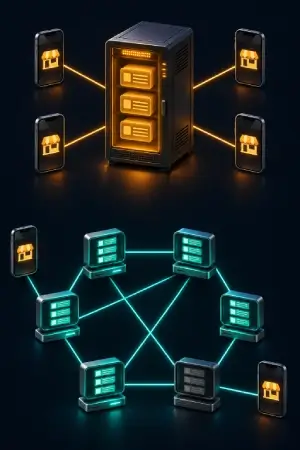
A typical banking app runs on servers the bank owns or rents from a provider like Amazon Web Services. The bank pushes updates when it chooses, keeps your transaction history in its own databases, and can freeze your account if something looks odd. You agreed to all of this when you tapped “accept” on the terms of service.
Social platforms work the same way. If Instagram tweaks its feed algorithm on a Tuesday, millions of creators feel it by Wednesday, and none of them got a vote. Marketplaces such as eBay set seller fees, settle disputes, and can delist a shop overnight.
There’s no denying this model has real advantages. One company can patch bugs quickly and staff a help desk. The catch is that users depend entirely on that company’s choices and on it staying in business.
What Decentralization Means in Practice
Decentralization means spreading control across many participants instead of leaving it with one owner. In a DApp, the core logic and records live on a peer-to-peer network, where computers connect directly to each other rather than through a central server. Each of these computers is called a node, and each one keeps a copy of the shared data.
Picture a marketplace where listings and payments are handled by code running on 4,000 nodes in 60 countries. No single firm can quietly raise fees or erase a seller’s history, because the network would have to accept the change. If a few nodes go offline, the rest keep the app running.
Ownership looks different too. The rules sit inside the software, and anyone can check them. Trust moves away from a company’s promises and toward a system people can inspect for themselves.
How DApps Work on Blockchain Networks
You don’t need an engineering degree to follow what happens behind the screen. A handful of building blocks do most of the work, and each one is easier to grasp than its name suggests.
A Shared Ledger Kept by Many Computers
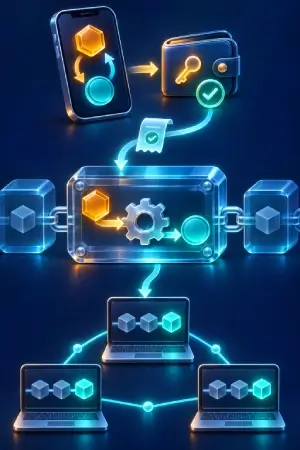
Think of a blockchain as a record book that thousands of people hold identical copies of. Every transaction gets written into a new “block,” which links to the one before it.
Those copies live on nodes, which are simply computers running the network’s software. Ethereum alone has well over 5,000 of them spread across dozens of countries. Because they constantly compare notes, no single machine can quietly rewrite history.
That’s what immutable means in practice. Once a payment or vote is confirmed, changing it would require overpowering most of the network at once, which is wildly expensive.
Smart Contracts and Wallets
Smart contracts are programs stored on the blockchain that run automatically when certain conditions are met. A lending app might hold your collateral and release it the moment your loan is repaid, with no clerk approving anything.
Your wallet, such as MetaMask or Phantom, acts as your login and signature. It holds the private key that proves an action really came from you.
What Happens When You Click “Submit”
Say Maria opens a DApp to swap $50 of one token for another. Her wallet asks her to approve the swap and pay a small fee. Nodes then check that she has the funds and that the contract’s rules allow it. Once enough of them agree, the result joins the ledger, usually within seconds.
Not everything she saw lived on the blockchain, though. Storing images and menus on-chain would be slow and costly, so most DApps keep those on ordinary servers or networks like IPFS. Balances and ownership stay on-chain. Some might argue that’s a compromise, and they’d have a point.
What Decentralization Buys Users
Knowing how a DApp is built only matters if the design changes something for the people using it. In practice, spreading an application across many computers shifts who holds power, who sets the rules and who can pull the plug.
Resistance to Censorship and Shutdown
Traditional apps live on servers one company controls, so a single decision or court order can freeze accounts overnight. A DApp runs on thousands of independent nodes, which are computers that each keep a copy of the network’s records. Switching one off barely registers.
That matters most for payments. Picture a freelance designer in Argentina paid in stablecoins. She can still receive funds even if a payment processor decides her country is too risky to serve.
Rules Anyone Can Read
Smart contracts are programs stored on the blockchain that carry out agreements automatically. Because their code is public, anyone can check how a lending app calculates interest or how a marketplace splits fees. Trust moves away from a company’s promises and toward open code that the network verifies collectively.
Creators feel this directly. A musician selling digital collectibles can lock in a 10% royalty on every resale, and no platform can quietly rewrite that term next quarter.
Ownership of Assets and Identity
With a crypto wallet, users hold their own keys, the secret codes that prove ownership. Gaming economies show why this appeals to people. A rare sword bought in a blockchain game belongs to the player, who can sell it elsewhere even if the studio shuts its servers.
There’s a catch, though. Lose those keys and no help desk can reset your password. Control and responsibility arrive in the same package.
Fewer Single Points of Failure
When a major cloud provider has an outage, dozens of popular services can go dark at once. Ethereum has kept producing blocks since 2015 because no single machine holds it up. For financial services that need to run around the clock, it’s easy to see why that resilience gets attention.
Why DApps Can Feel Slower and Less Convenient
Every design choice comes with a cost, and decentralization is no exception. The same features that protect users can also make everyday tasks feel clunky. A fair look at these trade-offs helps explain why many people still stick with familiar apps.
Waiting on the Network
When you tap “send” in a banking app, one company’s servers record the change almost instantly. A DApp has to wait for many independent computers, called nodes, to agree that the action is valid. On Ethereum, a new block is added roughly every 12 seconds, and some users wait for several blocks before treating a payment as final.
Fees add another layer of friction. Each action on a public blockchain usually requires a small payment, often called a gas fee, to reward the nodes doing the work. During busy stretches in 2021, a simple token swap could cost $50 or more, which made small purchases pointless.
Extra Steps Users Can’t Skip
Signing up for a mainstream service takes an email and a password. Using a DApp often means installing a digital wallet, saving a recovery phrase of 12 or 24 words, and approving each transaction by hand. Lose that phrase, and there’s usually no help desk to call.
Interfaces can also feel rough around the edges. Many DApps are built by small teams or volunteer communities on tight budgets, so polish sometimes takes a back seat to getting the code right.
Choosing the Right Tool for the Job
Centralized companies can fix bugs, change features, or reverse a mistaken payment overnight. Decentralized systems move more deliberately. Changes often need community approval, and smart contracts, the self-running code behind DApps, can be hard to alter once deployed.
So are DApps always the better choice? Not really. A photo-sharing app or a food delivery service gains little from running on a blockchain. DApps earn their place when openness, resilience, and user control matter more than raw speed. Think of cross-border payments in countries with unstable banks, or records that no single company should be able to edit.
How to Check Whether a DApp Is Worth Trusting
A DApp may be decentralized without being safe or useful. Before connecting a wallet, check who built the application, what permissions it requests and how much a mistake could cost.
Look Beyond the Decentralized Label
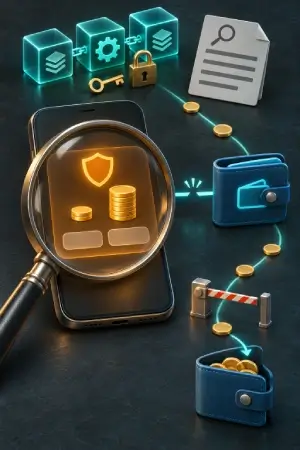
Not every feature of a DApp is managed by a blockchain. A project might store transactions on-chain while letting a small development team control its website, pricing information or contract upgrades. That can create points of failure that aren’t obvious from the homepage. Check whether the team explains who can change the contracts and whether those changes involve a delay or independent approval. If a project claims nobody can intervene but also reserves sweeping administrative powers, those statements deserve closer attention. Decentralization is not an all-or-nothing badge.
Check Security Before Connecting a Wallet
A smart contract audit can be helpful, but it isn’t a guarantee against bugs or fraud. Look for recent independent reviews, clear documentation and a record of how the project responded to earlier problems. Be cautious of unexpected wallet pop-ups or requests for unlimited token spending approval. Some approvals let a contract move assets later without asking again. Start with small amounts, read each transaction carefully and consider keeping most of your assets in a separate wallet. A polished interface should never replace basic checks.
Understand Your Exit Options
Before depositing funds, find out how withdrawals work and whether someone can pause them. A lending DApp may restrict withdrawals when markets become stressed, while a token with little trading activity can be difficult to sell at the expected price. Network fees also matter when you want to leave, especially if the balance is small. Check which network your assets use and whether you’ll need another token to pay transaction costs. Finally, ask what happens if the website disappears. The underlying contracts may survive, but reaching them directly can require skills most users don’t have.
DApps Change What Users Can Expect From Software
At their core, decentralized applications are programs that run on a blockchain’s peer-to-peer network instead of on servers owned by a single company. That design choice changes a lot. When a firm controls the software, it can change the rules, freeze an account or shut the service down overnight. A network-run application follows smart contracts that anyone can inspect, and it keeps working as long as enough nodes stay online. Users gain transparency, resilience and real control over their data and assets. The price is paid in speed and convenience, since transactions can take longer, fees fluctuate and a lost private key can’t be recovered by a help desk. Is that trade worth it? For plenty of people, maybe not yet. Still, there’s no denying that DApps mark a genuine shift in how digital services can be built, and in who gets to decide whether they can be trusted.