
Your bank flagged a suspicious charge before you noticed it. A retailer seemed to know you needed new running shoes. Neither was luck. Artificial intelligence now sits quietly inside everyday business operations, sorting data, spotting patterns and handling routine work. No science fiction required.
This plain-English guide explains what these tools actually do in commercial settings. It covers machine learning, analytics, forecasting, pattern detection and automation, then moves through everyday use cases, department-level applications and practical advice on adoption.
What Artificial Intelligence Does in Everyday Business Operations
Strip away the hype, and most workplace AI is software making judgment calls that once needed a person. A handful of capabilities do the heavy lifting. Machine learning describes systems that learn from data instead of following fixed rules. Predictive analytics uses those lessons to estimate likely outcomes. Natural language processing lets software understand and generate text or speech, while computer vision interprets images and video. Automation handles routine tasks from start to finish.
Companies adopt these tools for fairly plain reasons. They want work done faster and more consistently, at a scale no team could manage by hand, with better information behind every decision.
How Machine Learning Spots Useful Patterns
Give a machine learning model two years of card transactions, and it builds a picture of what normal spending looks like for each customer. When a cardholder in Leeds suddenly makes three purchases in Singapore within ten minutes, the system flags them almost instantly. Banks such as Barclays and JPMorgan Chase rely on this approach to catch fraud that human reviewers would spot far too late.
How Predictive Tools Support Forecasting
Guessing demand used to mean spreadsheets and gut instinct. Predictive analytics replaces much of that guesswork by weighing sales history, seasonality, local events, and weather. A grocery chain might learn that ice cream sales in its Phoenix stores jump 30 percent when temperatures pass 105°F, then order stock accordingly.
Walmart has used forecasting models for years to keep shelves full without tying up cash in excess inventory. Fewer empty shelves and less waste? It’s easy to see why finance teams like it.
How Automation Reduces Repetitive Work
Plenty of office work is sorting and copying. Natural language processing can read an incoming support email, recognize it as a billing complaint, and route it to the right team before anyone opens the inbox. Zendesk and Freshdesk build this kind of triage into their platforms.
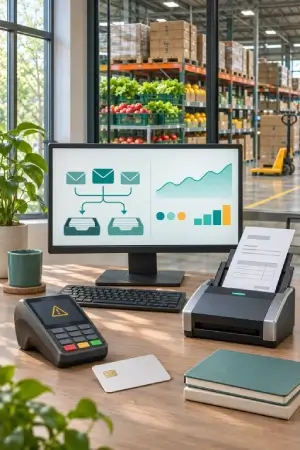
Invoices get similar treatment. Software combining computer vision and text recognition pulls supplier names, totals, and due dates from scanned PDFs, then enters them into the accounting system. An accounts payable clerk who once keyed in 200 invoices a day can now spend that time reviewing the odd exceptions.
Where Companies Use AI Every Day Across Core Functions
Most employees never see a dedicated AI project. They see a suggested reply in their inbox, a flagged invoice or a forecast that updated overnight. Machine learning usually lives inside tools people already use, handling the pattern-spotting that once ate up hours.
Customer Service and Sales
Chatbots now handle routine questions about order status, password resets and returns before a human gets involved. When a call does reach an agent, software can transcribe and summarize it, so nobody spends ten minutes writing notes afterward.
Sales teams lean on lead scoring, which ranks prospects by their likelihood to buy based on past deals. Amazon’s product recommendations run on similar logic. Inside CRM platforms like Salesforce, next-best-action prompts suggest whether a rep should offer a discount, book a demo or simply follow up on Thursday.
Marketing and Personalization
Segmentation used to mean splitting customers by age and zip code. Today’s models group people by behavior, like how often they browse and what they leave in carts. Campaign tools then shift budget toward the ads that perform, sometimes hour by hour.
Netflix made content recommendations famous, but retailers and publishers use the same approach. Send-time optimization picks the moment each subscriber is most likely to open an email. Churn prediction might be the most valuable of the lot. It flags customers showing early signs of leaving while there’s still time to win them back.
Operations, Supply Chain, and Finance
Demand forecasting helps a grocery chain decide how much yogurt to stock for a holiday weekend. UPS’s ORION system plans delivery routes and reportedly saves about 10 million gallons of fuel a year. Sensors on factory equipment trigger maintenance alerts days before a part fails.
Finance teams get similar help. Banks such as JPMorgan Chase score card transactions for fraud in milliseconds. Invoice tools read and log supplier bills automatically, and expense review software catches the duplicate hotel receipt nobody else noticed.
How AI Helps Businesses Detect Patterns and Make Better Decisions
Most companies already collect more data than any team could read in a year. Sales records, sensor logs, support tickets and payment histories pile up by the millions. Machine learning, software that learns patterns from past data instead of following fixed rules, makes that volume useful by separating noise from what actually matters.

Finding Signals in Large Data Sets
A human analyst might review a few hundred transactions before lunch. An AI model can scan millions overnight and surface the handful that look odd. Banks such as HSBC use this approach to flag suspicious activity, from unusual transfer amounts to logins from unfamiliar countries.
Manufacturers apply the same idea to quality control. Computer vision systems analyze camera images from the production line and can spot a hairline crack far faster than an inspector. Sensor data adds another layer by showing when a motor’s vibration hints at failure weeks ahead.
People data counts too. An HR team might notice that engineers who skip training and haven’t had a raise in 18 months tend to leave soon after.
Improving Forecasts and Planning
Forecasting is where predictive analytics earns its keep. The term simply means using historical data to estimate what’s likely to happen next. A retailer like Target can combine past sales, weather and local events to predict how many winter coats a Minneapolis store will need in early November.
Pricing benefits as well. Airlines and online sellers adjust prices daily based on demand shifts, competitor moves and customer behavior. A 2% margin gain adds up fast across thousands of products.
Turning Alerts Into Action
None of this replaces the manager. AI deals in probabilities, so a flagged transaction is a prompt to look closer. A compliance officer still decides whether an expense claim breaks policy or just reflects a messy business trip.
Timing is the bigger shift. Teams that once found problems in the quarterly review can now respond within days, with evidence in hand. It’s easy to see why managers value that. They get to act earlier, and with more confidence.
What Successful Day-to-Day AI Use Looks Like in Practice
Good results rarely look dramatic. They show up as shorter queues, cleaner forecasts and fewer late-night spreadsheet fixes, while people still make the calls that matter.

Common Benefits Businesses See
Time savings usually come first. A mid-sized insurer that automates claim intake might cut processing from four days to one, which frees adjusters for complex cases. Response times drop too, since chatbots and triage tools route simple questions in seconds.
Consistency is the quieter win. A model applies the same rules at 9 a.m. and 11 p.m., which lowers error rates in tasks like invoice matching. Better forecasting comes from the same pattern detection, so retailers order closer to real demand. Customers notice when the right product is in stock and their ticket reaches the right person on the first try.
Practical Limits and Risks
None of this works with messy data. Duplicate records, missing fields and outdated history produce confident but wrong outputs. Models trained on skewed history can also repeat old biases, which becomes a serious problem in hiring or lending.
Over-automation is another trap. Push a chatbot too far and frustrated customers start typing “agent” over and over. Privacy matters as well, especially when tools handle health, financial or employee data.
Then there’s trust. Staff who suspect AI is there to replace them will quietly work around it, and it’s easy to see why. Clear communication helps, and so does keeping humans in charge of reviewing high-stakes decisions.
How Companies Start Small
Most successful adopters pick one narrow, high-volume task with an obvious payoff. Document handling, support triage and stock forecasting are popular starting points because the before-and-after numbers are easy to measure.
Picture a regional grocery chain that tests demand forecasting in 12 stores for three months. If waste on fresh produce falls 18 percent, managers have a solid case for rolling it out further. If it doesn’t, the cost of learning was small.
Expansion works best when it’s gradual. Add one workflow at a time, keep tracking results and adjust before scaling again.
Keeping AI Useful After the First Rollout
Installing a tool is only the beginning. Once AI becomes part of a workday, businesses need to check that it still performs well and gives staff a way to question its output. Otherwise, small mistakes can become routine.
Building Checks Into Daily Workflows
A customer service assistant may answer delivery questions perfectly during a trial. Three months later, the company changes its returns policy, but nobody updates the information the assistant uses. Suddenly, customers get confident answers that are no longer correct.
That is why someone needs to own each AI-powered process. The customer service manager might review chatbot conversations every week, while the finance team checks how many invoices were matched incorrectly. When errors appear, employees should know how to report them and who can fix the problem.
Access controls matter too. A tool that summarizes internal documents should not automatically have permission to read payroll files or confidential contracts. Businesses need limits on what data enters a system, who sees the results and how long information is retained.
Measuring Results Beyond Time Saved
Speed is easy to measure, but it does not tell the whole story. A chatbot that closes twice as many tickets is not helping if customers have to contact support again the next morning. A forecasting tool that reduces stock shortages might still create waste by ordering too much of another product.
Useful measures depend on the task. Customer service teams can track repeat contacts and satisfaction scores. Finance teams can look at correction rates, processing costs and exceptions requiring human review. Operations teams can compare forecast accuracy against what actually sold.
Staff feedback belongs alongside those numbers. Employees often notice awkward steps or repeated mistakes before a dashboard does. Regular reviews help businesses decide whether to adjust the tool, change the workflow or stop using it altogether.
AI Is Becoming Part of Everyday Business Work
Strip away the headlines about robots and chatbots that write poetry, and a quieter picture comes into focus. Inside most companies, artificial intelligence works as steady operational support. It routes customer service tickets, sharpens marketing campaigns, flags odd transactions for finance teams, keeps warehouses stocked and feeds planning meetings with better numbers. Across all of these jobs, the pattern is the same. Businesses use machine learning to spot patterns people would miss, improve forecasts, automate repetitive tasks and help staff make sound decisions faster. A regional retailer that trims forecasting errors by 15 percent, or a bank that cuts fraud review time in half, rarely makes the news, yet those gains add up month after month. It’s easy to see why the strongest results tend to come from focused, everyday applications tied to a clear business need. Complexity for its own sake seldom pays the bills.